


Key Takeaways
- The time between therapy sessions is where the real learning happens in ERP treatment.
- Research shows homework adherence during ERP predicts both immediate and long-term improvement.
- Even 5 to 10 minutes of daily exposure practice can build meaningful progress.
- Trigger tracking helps you and your therapist identify patterns and measure change.
- Apps can provide structure, daily challenges, and psychoeducation between appointments.
- Self-help activities can become compulsive; if practice feels anxiety-driven, talk to your therapist.
- Self-directed ERP can help with milder OCD, and it tends to work better with some professional guidance.
- For more severe OCD, self-help works best alongside professional ERP therapy, not instead of it.
It is Thursday evening and you just left your weekly Exposure and Response Prevention (ERP) session feeling focused and capable. Your therapist walked you through an exposure, you resisted a compulsion, and for a few hours the world felt a little quieter. Then Saturday morning arrives. Obsessive-compulsive disorder (OCD) is loud again, pushing the same thoughts, the same urges, and you are standing in your kitchen wondering what to do with the six days between now and your next appointment.
If that gap between sessions feels like the hardest part of treatment, many people with OCD feel the same. The therapist's office is where you learn the skills. The rest of the week is where you practice them. That practice, the day-to-day work you do on your own, is what turns insight into lasting change. This guide covers whether you can do ERP on your own, practical self-help strategies for between sessions, tools that can support you, and honest guidance on when self-help is not enough.
Can You Do ERP on Your Own?
For some people, yes, especially if OCD is on the milder side. The best-supported version is guided self-help rather than ERP done entirely alone. UK guidelines from NICE list brief ERP using structured self-help materials, with a limited number of therapist hours, as a first option for adults whose OCD causes mild impairment. Studies of internet-based programs suggest that fully self-guided ERP can reduce symptoms too, though people seem less likely to stick with programs that have no human support at all. So self-directed ERP can work, and it tends to work better with at least some guidance from a professional.
Why ERP on Your Own Is Harder
The method is the same as in therapy. What is missing is someone outside the OCD who can see what you cannot. Three things tend to trip people up:
- Pitching exposures at the wrong level: Too easy, and there is little to learn from. Too hard, and it is tempting to give up or to end the exposure with a compulsion.
- Hidden compulsions: Mental reviewing, self-reassurance, or quietly checking that the exposure "went fine" can undo the practice without you noticing. Our list of mental compulsions can help you spot them.
- Turning ERP into reassurance: Researching the "right" way to do an exposure, or doing one to prove a fear wrong, keeps the search for certainty going.
How to Start Self-Directed ERP
Start by learning how ERP works. Then list the situations you avoid or perform rituals around, and rate how hard each one feels. Pick something in the lower middle of that list, stay with it without the compulsion for the time you planned, whether or not the urge eases, and repeat it before moving on to something harder. The aim is to practice living with the urge, not to wait for it to go away. Our guide to what ERP is and how it works explains how to build an exposure hierarchy step by step. If you are on a waitlist, the IOCDF's guidance on kick-starting OCD treatment while you wait is a useful place to begin, and the practice you do now gives you a foundation once therapy starts.
If your symptoms are severe, if OCD is mixed with depression or thoughts of suicide or self-harm, or if your practice keeps stalling, bring in a professional rather than pushing on alone. The signs further down this page can help you decide.
Why Between-Session Practice Matters for OCD Self-Help
Therapy sessions are important, but they typically account for one hour out of 168 in a week. The other 167 hours are where your brain does most of its learning. Between-session practice is not optional homework. It is the mechanism through which Exposure and Response Prevention actually works.
What the Research Shows
Studies consistently show that the amount of practice a person does outside of therapy sessions is one of the strongest predictors of how well ERP works. A 2020 study published in the Journal of Anxiety Disorders found that adherence to between-session ERP assignments predicted improvements across specific OCD symptom dimensions. A separate systematic review in Cognitive Therapy and Research confirmed that homework completion is a robust predictor of outcomes in ERP for OCD. In short, the therapy session plants the seeds. What you do between sessions is what makes them grow.
What "Between-Session Practice" Actually Looks Like
Between-session practice does not mean sitting down for an hour of formal therapy every day (though some people work up to that). For most people, it looks more like a series of small, intentional choices woven into daily life. You might spend ten minutes practicing an exposure from your hierarchy before breakfast. You might notice a compulsive urge while driving and choose to delay acting on it. You might jot down a few lines in a trigger log at the end of the day. These micro-exposures and mini-experiments, as described in practical guides on ERP at home, are how your brain gradually learns that it can tolerate discomfort without resorting to compulsions.
OCD Self-Help Strategies That Support ERP
The following strategies are grounded in evidence and designed to complement what you are working on with your therapist. Each one is something you can start today, even if you are early in treatment or still figuring out your exposure hierarchy.
Planned Daily Exposures
Set aside a specific time each day to practice one exposure from your hierarchy. It does not need to be long. Even 5 to 10 minutes of focused, intentional exposure practice is meaningful. The International OCD Foundation (IOCDF) recommends working toward 1 to 2 hours of daily practice for optimal results, but any consistent practice is better than waiting for the perfect block of time. The key is regularity: a short daily session builds more momentum than a long session once a week.
Response Prevention in Real Time
Planned exposures are valuable, but OCD does not only show up during scheduled practice. When a compulsive urge strikes during the day, try delaying the compulsion rather than fighting it head-on. Start small. If you feel an urge to check, wait five minutes before acting on it. If the urge passes, notice that. If it does not, notice that you managed to wait anyway, and try extending the delay a little next time. Over time, these small acts of response prevention teach your brain that you can carry the urge without acting on it, whether it fades quickly or not.
Trigger Tracking and Journaling
Keeping a brief daily log of your OCD experiences can be a powerful self-help tool. Note what triggered you, whether you performed or resisted a compulsion, and roughly how long the discomfort lasted. This kind of data serves two purposes. First, it helps you notice patterns you might otherwise miss, like certain times of day or situations that consistently spike anxiety. Second, it gives your therapist concrete information to work with, making your sessions more focused and productive.
Mindful Observation Without Engagement
When an intrusive thought appears, practice labeling it: "That is an OCD thought." Then let it be there without reacting. This is not about pushing the thought away or replacing it with something positive. It is about changing your relationship with the thought. Instead of treating it as a signal that demands action, you acknowledge it as mental noise that can come and go on its own. This approach draws on mindfulness principles and works well alongside formal ERP practice.
Values-Based Action
On days when OCD feels especially loud, it can help to ask yourself a simple question: "What would I choose to do right now if OCD were not making the decision?" Then do that thing, even imperfectly. This draws from Acceptance and Commitment Therapy (ACT) principles and can be particularly helpful when motivation for exposure practice is low. Rather than waiting for anxiety to decrease before re-engaging with your life, you move toward what matters to you and let the discomfort come along for the ride. Over time, this builds a sense of agency that OCD erodes.
How Apps Can Support OCD Self-Help Between Sessions
Technology is not a replacement for therapy, but the right tools can fill the gap between appointments. For many people, an app provides the structure and consistency that paper-based methods struggle to maintain.
Structured Daily Challenges
One of the hardest parts of between-session practice is deciding what to work on each day. Apps that deliver structured daily ERP exercises take the guesswork out of that question and help you build a consistent routine. For a closer look at how challenge-based apps work, see our guide to OCD challenge apps.
Symptom Tracking and Pattern Detection
Digital tracking tends to be more consistent than pen-and-paper logs, and it can surface patterns you might not notice on your own. When you can see a graph showing how you evolved over time, that visual feedback can be motivating on days when progress feels invisible.
Psychoeducation On Demand
There will be moments, often late at night, when you need a reminder of why response prevention works or what is happening in your brain when OCD spikes. A well-designed app can deliver that information without turning the search into a reassurance-seeking session. For a broader overview of what to look for in an OCD app, see our guide to OCD apps.
AI-Powered Personalization
Some newer apps use artificial intelligence (AI) to adapt exercises to your specific OCD themes and track your progress over time. This means the practice you are offered can evolve as you do, rather than following a one-size-fits-all script. For a deeper look at how AI is being used in OCD care, see our article on AI for OCD.
OCD Self-Help Tools and When to Use Them
Different self-help strategies serve different purposes. The table below can help you identify which tools fit your current needs and where each one has limits.
| Tool | Best For | Limitations |
|---|---|---|
| Planned daily exposures | Building ERP skills between sessions | Requires knowing your hierarchy; therapist guidance helps |
| Response delay (in the moment) | Real-time practice when compulsions strike | Can be very difficult without prior practice |
| Trigger journaling | Identifying patterns and informing therapy | Can become a compulsion itself if overdone |
| Mindful observation | Changing your relationship with intrusive thoughts | Not a standalone treatment; works best alongside ERP |
| OCD apps (challenge-based) | Structured daily practice, tracking, consistency | Varies widely in quality; choose evidence-based tools |
| OCD apps (psychoeducation) | Learning about OCD and understanding ERP concepts | Information alone does not treat OCD |
| Values-based action | Reclaiming agency on difficult days | Works best with ACT training or therapist guidance |
When OCD Self-Help Is Not Enough
Self-help strategies can be a meaningful part of managing OCD, but they have limits. Recognizing those limits is not a failure. It is a sign of good judgment.
Signs You May Need More Support
Consider reaching out to a licensed mental-health professional who specializes in OCD if any of the following apply:
- Your symptoms are worsening despite consistent self-help practice.
- You are spending more than an hour a day on compulsions.
- You are avoiding major areas of your life, such as work, relationships, or daily routines.
- Starting or sustaining self-help practice feels impossible on most days.
- You feel stuck in the OCD cycle no matter what you try.
- OCD is mixed with low mood or depression, or you are having thoughts of suicide or self-harm.
If you are in crisis or feel you may act on thoughts of suicide or self-harm, contact the 988 Suicide and Crisis Lifeline by calling or texting 988 (U.S.), or visit findahelpline.com for international resources. Unwanted, frightening thoughts about harming yourself can also be an OCD theme, which our guide to harm OCD covers.
When Self-Help Becomes a Compulsion
This is an important caveat. For some people, self-help activities themselves can cross the line from helpful to compulsive. Journaling every thought in exhaustive detail, tracking symptoms multiple times a day, or spending hours researching OCD can start to function as compulsions if they are driven by anxiety rather than chosen freely. As Mind UK notes in their self-care guidance, the line between productive self-care and compulsive behavior is not rigid. If your self-help practice feels like something you must do to prevent something bad from happening, or if skipping it triggers significant anxiety, that is worth discussing with your therapist. Healthy practice involves intentional engagement with discomfort, not avoidance disguised as productivity.
Final Note
The space between therapy sessions can feel like a long stretch when OCD is active. But that space is not empty, and the work you do in it is not a lesser version of therapy. It is where your brain actually learns, through real-world repetition, that it can sit with discomfort without reaching for a compulsion. Some days that practice will feel like progress. Other days it will feel like a step backward. Both are part of the process.
What matters most is showing up, even imperfectly and even briefly. Five minutes of intentional practice on a hard day counts. Noticing an urge and choosing to wait counts. Picking up where you left off after a difficult week counts. If you are practicing without a therapist for now, a licensed specialist in OCD can help you build a plan that fits your life when you are ready, and the IOCDF therapist directory is a good place to start.
FAQ for OCD Self-Help Between Sessions
What can I do for OCD between therapy sessions?
You can practice planned daily exposures from your hierarchy, track triggers and anxiety levels in a brief log, practice response delay when compulsive urges strike, and use evidence-based apps for structured daily challenges. Even brief, consistent practice supports the learning your brain is doing in ERP therapy. The key is regularity rather than duration.
Is OCD self-help effective?
Self-help strategies grounded in ERP principles can meaningfully support recovery, especially when used alongside professional therapy. Research shows that homework adherence is one of the strongest predictors of ERP outcomes. Self-help alone may help with mild symptoms, but for moderate to severe OCD, working with a trained therapist is the recommended path.
Can you do ERP for OCD by yourself?
Some people can, especially with milder OCD and a structured program such as a workbook or an app built on ERP. The hardest parts are spotting your own hidden compulsions and keeping exposures challenging but manageable, which is where even a few sessions with an ERP therapist help. If symptoms are severe or not improving, self-directed ERP works best as a bridge to professional care rather than a replacement for it.
How much time should I spend on OCD self-help each day?
Clinical guidelines suggest daily practice for the best results. Even 5 to 15 minutes of focused exposure practice can be valuable. Consistency matters more than duration, so a short daily session tends to be more effective than a longer session once a week. Talk with your therapist about a realistic daily commitment based on your specific situation.
Can OCD self-help make things worse?
It can, if self-help activities become compulsive. Journaling every thought in exhaustive detail, tracking symptoms multiple times a day, or spending hours researching OCD can cross the line from helpful to compulsive when they are driven by anxiety rather than chosen freely. Effective self-help involves intentional practice with discomfort, not avoidance disguised as productivity. If something about your practice feels impossible to skip, bring it up with your therapist.
What is the best OCD self-help app?
The best app depends on your needs, but look for one built on ERP principles with clinical input, personalization to your OCD themes, and tools for daily practice and tracking. Avoid apps that rely on reassurance or relaxation alone, as these do not address the OCD cycle. For a detailed breakdown of what to look for, see our guide to OCD apps.
What should I do if I am on a waitlist for OCD therapy?
Start with psychoeducation by learning about OCD and how ERP works. Try gentle self-directed exposure practice at a comfortable pace, track your symptoms, and consider an evidence-based OCD app for structure. These steps can help prevent symptoms from worsening while you wait for professional care to begin.
How do I know if I need more than self-help for OCD?
If your symptoms are worsening, consuming more than an hour a day, or causing you to avoid important parts of your life, professional support is the right next step. Self-help is a valuable complement to treatment, not a replacement for working with a licensed therapist trained in ERP. A specialist can help you build an exposure hierarchy tailored to your specific OCD themes.

Mourice writes about obsessive-compulsive disorder (OCD) from lived experience and as co-founder of ObsessLess, focusing on making intrusive thoughts, compulsions, and recovery concepts easier to understand and apply in everyday life.


Dr. Marina Gershkovich (PhD, ABPP) writes about obsessive-compulsive disorder (OCD) as a board-certified clinical psychologist, researcher, and Founding Clinical Advisor to ObsessLess. Specializing in evidence-based treatments like CBT and ERP, she focuses on translating clinical research into practical, accessible strategies to help people manage intrusive thoughts, reduce compulsions, and improve treatment outcomes.
Download the OCD Relief Guide
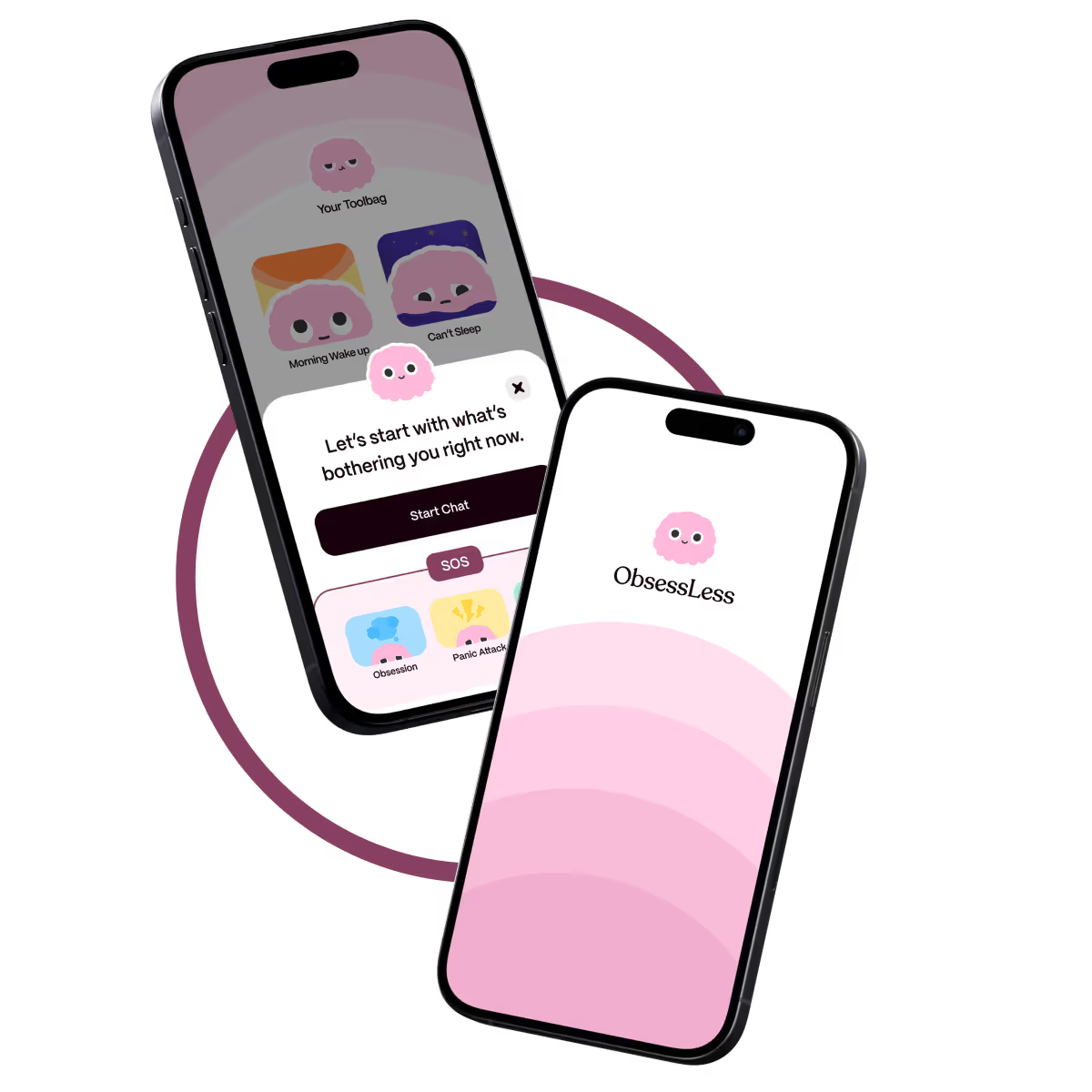
Get Instant OCD Support

Download the OCD Relief Guide