

Key Takeaways
- Homework completion is the strongest predictor of ERP treatment outcomes.
- Challenge-based OCD apps break ERP into daily micro-exposures.
- Gamified mental health apps can achieve up to 90% adherence rates.
- Effective OCD challenge apps are built on ERP, not generic wellness.
- Small, consistent daily practice builds stronger habits than long sessions.
- Challenge apps work best alongside professional ERP therapy.
Monday evening, you leave your therapist's office feeling motivated. You practiced an exposure in session, talked through your hierarchy, and your therapist reminded you to do at least one exercise each day before your next appointment. By Wednesday, life has gotten in the way. You meant to practice, but the exercises felt too big to start on your own, and there was no structure to follow once you sat down. By the time Friday rolls around, the momentum from that session has faded entirely.
If this pattern sounds familiar, you are far from alone. The gap between understanding how Exposure and Response Prevention (ERP) works and actually doing it every day is one of the biggest obstacles in obsessive-compulsive disorder (OCD) treatment. Challenge-based OCD apps are designed to close that gap. By turning ERP homework into structured, bite-sized daily challenges, these tools make it easier to show up for practice, even on the days when motivation is low.
Why Daily ERP Practice Matters More Than You Think
It is easy to assume that the real work of ERP happens in therapy sessions. But research tells a different story. What you do between sessions, the daily practice, the homework, is what drives lasting change. Skipping a week of practice and then doing a long session the night before your appointment is not the same as showing up for a few minutes each day.
The Research on ERP Homework
A systematic review published in Cognitive Therapy and Research found that homework completion is one of the most robust predictors of positive outcomes in ERP for OCD. People who consistently completed their between-session assignments improved more than those who did not, regardless of how severe their symptoms were at the start.
A separate study on patient adherence went further, showing that homework completion predicted not just short-term improvement but outcomes at six-month follow-up. In other words, the daily work you put in now has a compounding effect. It shapes how well you respond to treatment today and how well those gains hold up months later.
The Problem with Traditional Homework
Knowing that daily practice matters is one thing. Actually doing it is another. Traditional ERP homework often comes in the form of open-ended instructions: "Practice sitting with uncertainty around contamination this week" or "Try not to check the locks more than once." These assignments are clinically sound, but they lack the structure many people need to follow through.
Without a clear starting point, a defined duration, or a way to track progress, it is easy for homework to slip. There is no reminder, no feedback loop, and no sense of where you left off. For many people, the result is a pattern of good intentions followed by inconsistent practice, which slows down the very progress they are working toward.
What Is a Challenge-Based Approach?
A challenge-based approach takes the principles of ERP and packages them into structured, daily exercises that are easier to start and easier to stick with. Instead of vague weekly assignments, you get a specific exercise for today, with clear instructions and a manageable time commitment.
Micro-Exposures
The core idea behind challenge-based OCD apps is the micro-exposure: a short, focused ERP exercise that typically takes between 1 and 15 minutes. Rather than asking you to tackle your most feared scenario all at once, a micro-exposure targets a specific trigger at a level you can handle right now.
This approach aligns with clinical guidance. The International OCD Foundation (IOCDF) recommends at least one to two hours of daily exposure practice for optimal results, noting that at that level of consistency, most people begin to desensitize to a specific trigger within five to seven days. Shorter sessions may take longer to produce the same effect, but they still build momentum and are a meaningful starting point, especially for people who feel overwhelmed by the idea of longer practice blocks.
Progressive Difficulty
Effective challenge apps mirror the exposure hierarchy used in clinical ERP. You start with exercises that are mildly uncomfortable and gradually work your way toward more difficult ones. This progression is not about rushing through fear. It is about building tolerance step by step, so each new challenge feels like a stretch rather than a leap.
A well-designed app acts as a digital exposure ladder. Early challenges might involve reading a triggering word or delaying a compulsion by thirty seconds. Later challenges could involve longer delays, new trigger contexts, or exercises that combine multiple themes. The key is that difficulty increases at a pace that matches your growing capacity to tolerate discomfort.
Streaks and Consistency Cues
Many challenge apps use streaks, reminders, and visual progress indicators to encourage daily practice. This is not about competition or earning points for their own sake. It is about making consistency visible. When you can see that you have practiced four days in a row, there is a natural motivation to keep the streak going. When you miss a day, the app can gently prompt you to get back on track rather than letting days turn into weeks.
These cues work because they make the habit of daily practice feel concrete. Instead of a vague intention to "practice more," you have a tangible record of what you have done and a clear invitation to continue.
The Science of Habit Formation in Mental Health Apps
Challenge-based OCD apps draw on a growing body of research about how gamification and habit-forming design can improve engagement with mental health tools. The evidence is encouraging, but it comes with important caveats.
Why Gamification May Help in Mental Health
A 2019 systematic review in JMIR Mental Health cataloged the gamification elements used across mental health apps, finding that features like progress tracking, challenges, and rewards were associated with higher user engagement. A later meta-analysis spanning 38 studies and over 8,000 participants found that mental health apps were effective overall, though the number of gamification elements did not independently predict better outcomes. The research is still emerging, and the evidence so far suggests that how gamification is implemented matters more than whether it is present.
One of the most cited examples is the eQuoo randomized controlled trial, which found that a gamified mental health app achieved a 90% adherence rate and 21% better retention compared to its control group. While eQuoo targeted resilience rather than OCD specifically, the study demonstrates that thoughtful gamification can meaningfully improve how consistently people use therapeutic tools.
Intrinsic vs. Extrinsic Motivation
Not all gamification is created equal. A 2023 review on gamification in digital mental health highlights the distinction between extrinsic motivators (points, badges, leaderboards) and intrinsic motivators (a sense of progress, mastery, and personal relevance). Extrinsic rewards can get someone started, but sustained engagement depends on the person feeling that the challenges are meaningful to their own recovery. The most effective mental health apps tap into intrinsic motivation by making the experience feel personally relevant and progressively rewarding.
When Gamification Backfires
Gamification in mental health is not automatically helpful. If challenge features are poorly designed, they can feel patronizing, trivializing, or disconnected from the actual therapeutic work. An OCD app that awards points for completing generic relaxation exercises, for example, misses the point entirely if the person needs to practice sitting with discomfort rather than reducing it.
The litmus test is whether the gamified elements serve the clinical methodology. Streaks that encourage daily ERP practice are useful. Leaderboards that turn anxiety management into a competition are not. When evaluating an OCD challenge app, the question is not "is it gamified?" but "does the gamification support real ERP practice?"
Traditional ERP Homework vs. App-Based Challenges
| Aspect | Traditional ERP Homework | App-Based Daily Challenges |
|---|---|---|
| Structure | Open-ended ("practice this week") | Specific, timed, daily exercises |
| Guidance | Therapist instructions from last session | Step-by-step in-app prompts |
| Tracking | Self-reported at next session | Automatic logging and streaks |
| Difficulty progression | Therapist adjusts at next appointment | App adapts progressively |
| Accountability | Next therapy session (often weekly) | Daily reminders and check-ins |
| Accessibility | Requires remembering instructions | Available on your phone anytime |
| Time commitment | Variable, can feel overwhelming | Bite-sized (5-15 minutes) |
| Feedback | Delayed until next session | Immediate progress indicators |
What to Look For in an OCD Challenge App
Not every app that promises daily challenges is built on sound clinical principles. Here is what matters most when you are evaluating your options.
ERP-Based Challenges, Not Generic Wellness
The single most important criterion is whether the challenges are grounded in ERP methodology. Effective OCD challenges involve facing triggers and resisting compulsions, not deep breathing, positive affirmations, or distraction techniques. Those approaches have their place, but they are not ERP, and they do not address the OCD cycle at its root. Look for an app that explicitly structures its challenges around exposure and response prevention.
Personalization to Your OCD Themes
OCD is not one-size-fits-all. A contamination-focused challenge is irrelevant to someone dealing with harm-related intrusions, and a checking-focused exercise will not help someone whose primary struggle involves intrusive thoughts. The app should adapt its challenges to your specific OCD themes so that each exercise targets what you are actually working on. Some apps use AI-driven personalization to tailor challenge difficulty and content to your responses over time.
Therapist Compatibility
An app that works alongside your therapist is more valuable than one that operates in isolation. Look for features that allow your therapist to view your progress, assign specific challenges, or adjust your difficulty level remotely. This kind of integration means your daily practice and your therapy sessions reinforce each other, rather than running on parallel tracks.
Progress Tracking That Measures What Matters
A streak counter tells you how many days you have practiced. That is useful, but it does not tell the whole story. The best OCD challenge apps also track metrics like distress tolerance over time, how long you can sit with discomfort before it naturally decreases, and which triggers are becoming less activating. These are the signals that matter most to you and your therapist when evaluating whether daily practice is translating into real progress.
Building an ERP Habit That Sticks
Whether or not you use an app, these strategies can help you turn daily ERP practice from something you intend to do into something you actually do.
Start Smaller Than You Think
If the idea of daily practice feels daunting, you are probably thinking too big. A five-minute exercise where you sit with a mildly triggering thought is a perfectly valid starting point. The goal at the beginning is not intensity. It is consistency. Once the habit of showing up each day is established, you can gradually increase the difficulty and duration.
Use "If-Then" Planning
One of the most effective habit-building strategies is tying a new behavior to an existing routine. Instead of telling yourself "I will practice ERP today," try "After I finish my morning coffee, I will open the app and do one challenge." This kind of if-then planning, sometimes called habit stacking, removes the decision-making step that often leads to procrastination.
Have a Low-Energy Backup Plan
Some days are harder than others. On a tough day, a 15-minute exposure exercise might feel impossible. That is okay. Having a low-energy backup, like a two-minute challenge or simply reading through an exposure script, keeps the habit alive without requiring peak motivation. A sustainable habit is one that survives bad days, not just good ones.
Track Process, Not Just Outcomes
It is tempting to measure progress by how anxious you feel. But anxiety reduction is not always linear, and focusing on it too much can become its own form of checking. Instead, track whether you showed up. Did you complete today's challenge? Did you resist a compulsion, even partially? Over time, these process-focused metrics paint a more accurate and encouraging picture of your growth.
How Challenge Apps Fit Into Treatment
Challenge-based OCD apps are most effective when they complement professional care rather than replace it. Your therapist guides the overall treatment plan, builds your exposure hierarchy, and helps you navigate the moments that feel too big to handle alone. The app supports the daily practice between sessions, giving you structure, accountability, and a low-barrier way to keep building on what you work on in therapy.
For a deeper look at how ERP therapy works and what to expect from the treatment process, see the full guide on Exposure and Response Prevention. If you are exploring broader options for managing OCD between sessions, the guides on OCD apps and OCD self-help strategies cover additional tools and approaches.
Final Note
The sessions with your therapist plant the seeds. Daily practice is what helps them take root. Challenge-based apps can make that practice less daunting by giving you a clear starting point, a manageable time commitment, and a visible record of the work you are putting in.
Even on the days when motivation is low and OCD feels loud, a small challenge completed is a step forward. You do not need to do it perfectly. You do not need to feel ready. You just need to show up, do the exercise, and let the consistency do its work over time.
If you are considering adding a challenge-based app to your routine, talk with a licensed mental-health professional who specializes in OCD. They can help you choose a tool that fits your treatment plan and ensure your daily practice is targeting the right areas. Consistency matters more than perfection, and every day you practice is a day you are building something lasting.
FAQ for OCD Challenge Apps
What is an OCD challenge app?
An OCD challenge app is a mobile tool that delivers structured, daily ERP-based exercises designed to help you practice facing your OCD triggers in small, manageable steps. Unlike generic wellness apps, effective OCD challenge apps build their exercises around exposure and response prevention principles, guiding you through progressively difficult challenges that mirror the work you do in therapy.
How often should I practice ERP?
Research and clinical guidelines point to daily practice as the most effective approach. The IOCDF recommends one to two hours of daily practice for optimal results, noting that most people begin to desensitize to a specific trigger within five to seven days at that level of consistency. Even briefer daily sessions of 5 to 15 minutes can build meaningful momentum and tend to produce better results than occasional longer ones, though they may take more time to achieve the same degree of desensitization. For a full overview of what ERP involves, see our guide on Exposure and Response Prevention.
Can I do ERP challenges without a therapist?
Self-directed ERP is possible for milder symptoms, and apps can provide helpful structure. However, working with a licensed therapist who specializes in ERP produces the best outcomes, particularly for moderate to severe OCD. A therapist can build your exposure hierarchy, adjust the plan as you progress, and support you through the harder moments. Apps are most effective as a supplement to professional care, not a full replacement.
Do gamified OCD apps actually work?
Research on gamification in mental health apps shows improved engagement and retention. A randomized controlled trial of one gamified app found a 90% adherence rate and 21% better retention versus a control group. The key factor is whether the gamification serves the clinical methodology. Points and streaks that encourage consistent ERP practice can be genuinely useful. Gamification that distracts from therapeutic work or trivializes the experience is not.
What if I miss a day of OCD challenges?
Missing a day does not undo your progress. What matters is the overall pattern of consistency, not perfection on any single day. Having a low-energy backup plan, like a two-minute exercise or reading through an exposure script, can help you maintain the habit even on difficult days. If you miss one day, the most helpful thing you can do is simply pick up again tomorrow.
How do OCD challenge apps differ from regular OCD apps?
Challenge apps emphasize structured daily practice with progressive difficulty, while broader OCD apps may focus on psychoeducation, symptom tracking, or connecting you with a therapist. Many apps include challenge features alongside other tools. The distinguishing factor is whether the app delivers daily, ERP-grounded exercises that build on each other over time. For a wider comparison, see our guide on OCD apps.

Mourice writes about obsessive-compulsive disorder (OCD) from lived experience and as co-founder of ObsessLess, focusing on making intrusive thoughts, compulsions, and recovery concepts easier to understand and apply in everyday life.

Download the OCD Relief Guide
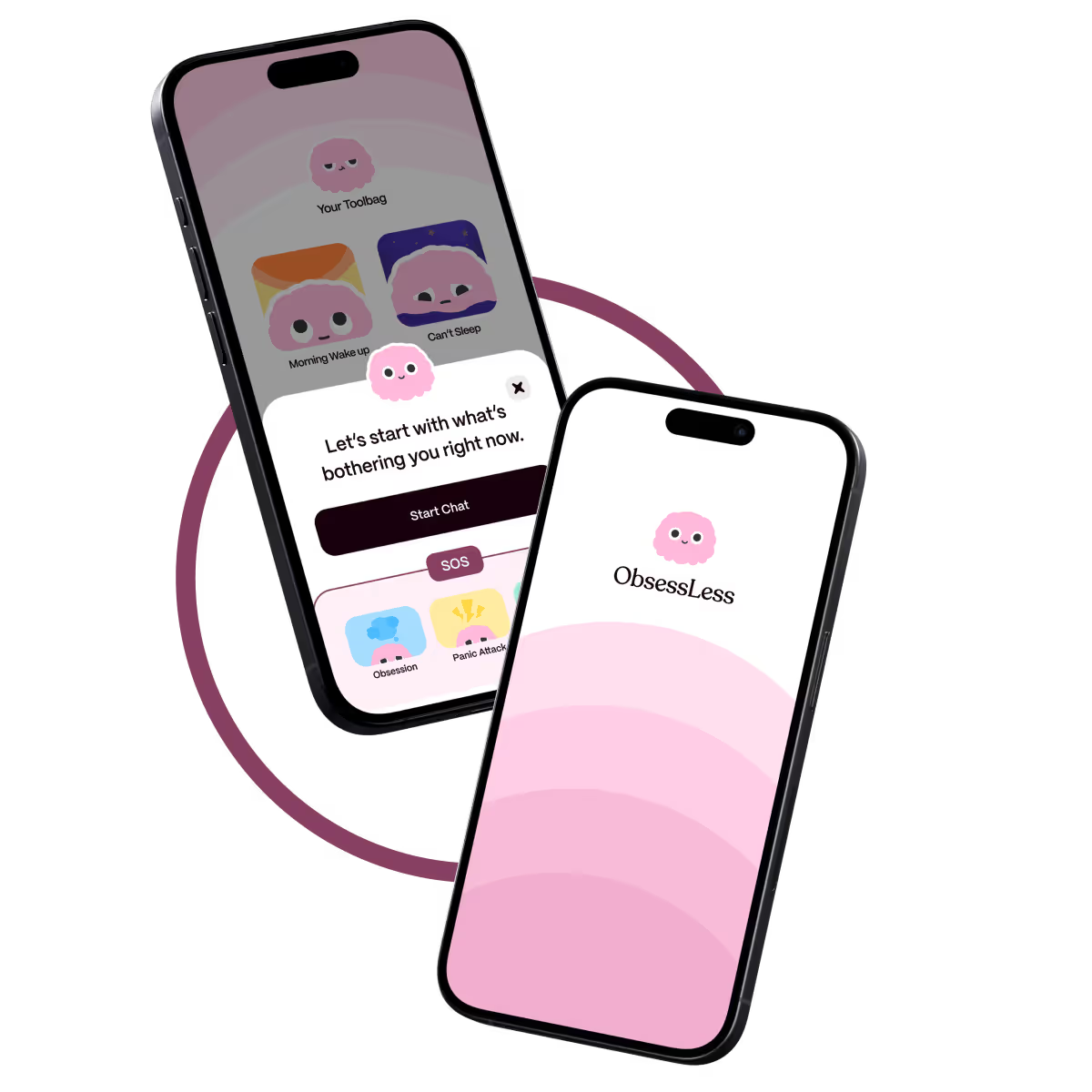
Get Instant OCD Support

Download the OCD Relief Guide