

Key Takeaways
- OCD apps work best alongside professional ERP therapy, not as replacements.
- Clinical trials show app-based CBT can produce significant symptom improvement.
- Most effective OCD apps are built on ERP or CBT with specialist input.
- Free apps can be a helpful starting point; paid tiers offer personalization.
- Watch for red flags like cure promises or missing evidence-based methodology.
- Choosing an app is one piece of the puzzle; a trained therapist remains most impactful.
Picture this: you have just learned that what you have been experiencing has a name, obsessive-compulsive disorder (OCD). Your therapist mentioned something called Exposure and Response Prevention (ERP). You are still processing the diagnosis, but already your instinct is to pull out your phone and search for help. The app store returns dozens of results for "OCD app," each promising relief, progress, or even recovery. Some are free. Some cost more than your copay. Most have cheerful icons and five-star reviews that tell you very little about what is actually inside. How do you decide which one, if any, is worth your time?
The reality is that the OCD app landscape is growing fast, and not every app is built on solid ground. Some are grounded in evidence-based approaches to OCD, while others rely on generic relaxation techniques that may not address the condition at its core. This guide will walk you through what OCD apps actually do, what the research says about them, how to tell the good from the questionable, and how apps fit into a broader treatment plan.
What Do OCD Apps Actually Do?
OCD apps are not a single category. They range from simple mood trackers to full platforms connecting users with licensed therapists. Understanding the different types can help you figure out which kind of support you are looking for.
ERP-Based Practice Tools
These apps guide users through exposure and response prevention exercises, the gold-standard treatment for OCD. They may help you build an exposure hierarchy, practice sitting with discomfort, and track your progress over time. Some use AI-powered features to personalize exercises to your specific OCD themes, whether those involve contamination fears, harm-related intrusions, or other patterns.
Symptom Tracking and Journaling
Tracking apps let you log triggers, compulsions, mood shifts, and patterns over time. This kind of data can be valuable for both you and your therapist. When you can see that certain situations or times of day consistently spike your anxiety, it becomes easier to plan targeted exposures and measure whether things are shifting.
Psychoeducation and Self-Help
Some OCD apps focus primarily on teaching. They explain what OCD is, how the obsession-compulsion cycle works, and what intrusive thoughts are. For someone who is newly diagnosed or still learning about the condition, psychoeducation can be a meaningful first step. These apps may also include guided mindfulness exercises, though it is worth noting that mindfulness alone is not a treatment for OCD.
Therapist-Connected Platforms
A newer category of OCD apps pairs users directly with licensed OCD therapists for remote sessions. These platforms function more like telehealth services with an app wrapper. They can be especially useful for people who live in areas without local OCD specialists, though they typically come with a subscription or per-session cost.
What the Research Says About OCD Apps
The evidence base for app-based OCD interventions has grown considerably in recent years. While no app can replicate the full experience of working with a skilled therapist, several studies suggest that technology-assisted cognitive behavioral therapy (CBT) can produce real, measurable improvement.
A 2025 randomized controlled trial published in npj Digital Medicine tested a smartphone-based CBT program for OCD against a control condition. The app group showed a 65% response rate and 26% achieved remission, numbers that are notable for a coach-supported, app-based tool that required less than 1.5 hours of clinical time per patient. Researchers at Harvard and Massachusetts General Hospital have described this as a promising step toward making OCD treatment more accessible, particularly for people who face barriers like cost, geography, or long waitlists.
A separate study in JMIR Mental Health compared app-delivered CBT with traditional face-to-face CBT and found comparable outcomes on key measures. And a large-scale study of over 3,500 adults using a therapist-connected OCD platform (published in PubMed) showed significant reductions in OCD severity over the course of treatment.
A recent systematic review of internet-based CBT for OCD found large effect sizes across multiple trials, suggesting that digital delivery of CBT can be comparable to in-person therapy for many people.
Key Findings from Clinical Trials
- App-based CBT for OCD has achieved response rates of up to 65% in randomized controlled trials.
- Digital CBT can produce outcomes comparable to traditional face-to-face therapy on several key measures.
- Therapist-connected platforms show significant reductions in OCD severity across large samples.
- Internet-based CBT meta-analyses report large effect sizes, supporting digital delivery as a viable format.
- Consistency of use matters. Participants who engaged regularly with app exercises saw the most benefit.
What to Look For in an OCD App
Not every app that mentions OCD is designed with clinical rigor. Here are the features and qualities that separate the helpful from the hollow.
Evidence-Based Methodology
The single most important question to ask about any OCD app is whether it is built on ERP or CBT principles. These are the approaches with the strongest evidence for treating OCD. Look for apps that explicitly name their methodology and, ideally, have OCD specialists on the clinical team. If an app talks about "reducing anxiety" or "finding calm" without mentioning exposure-based techniques, it may not address OCD specifically.
Personalization
OCD shows up differently for everyone. An app that offers generic exercises may be fine for learning the basics, but for meaningful practice, you want something that adapts to your specific themes and severity. Some apps ask about your OCD subtypes during onboarding and tailor content accordingly. This kind of personalization can make the difference between exercises that feel relevant and ones that feel like busywork.
Privacy and Data Security
Mental health data is deeply personal. Before downloading an OCD app, check how it handles your information. Does it encrypt your data? Does it share information with third parties? Is there a clear, readable privacy policy? The National Institute of Mental Health (NIMH) notes that data privacy is one of the most important factors to evaluate when choosing a mental health app.
Professional Oversight
Apps built with input from licensed OCD therapists tend to be more clinically sound than those created purely by software developers. Some apps include direct therapist access, while others are designed as self-guided tools with clinical advisory boards. Either model can work, but knowing whether mental health professionals were involved in the design is a useful signal.
Ease of Use and Accessibility
An app is only helpful if you actually use it. Consider whether the interface is intuitive, whether it is available on your device, and whether the design makes you want to come back. Accessibility features like text scaling, screen reader support, and offline access can also matter, especially if you plan to use the app during moments of high anxiety when connectivity may not be guaranteed.
Free vs. Paid OCD Apps
One of the most common questions people ask when searching for an OCD app is whether a free option can do the job. The honest answer is: it depends on what you need.
What Free OCD Apps Typically Include
Most free OCD apps offer a baseline of psychoeducational content, such as articles or videos explaining OCD and its treatment. Some include basic symptom tracking or a limited library of generic exercises. Community features, like forums or peer support, are also common in free tiers. These features can be genuinely useful if you are in the early stages of understanding OCD or if you want a low-commitment way to explore what is available.
What Paid Subscriptions Add
Paid OCD apps tend to unlock more depth. That might mean personalized ERP exercises tailored to your specific OCD themes, AI-driven coaching that adapts to your progress, access to licensed therapists through chat or video, and detailed analytics that help you and your treatment provider track trends over time. Some paid apps also offer offline access and enhanced privacy controls.
Is a Free App Enough?
If you are looking for a starting point, a free OCD app can provide useful education and basic structure. If you are looking for something that actively supports ERP practice between therapy sessions, a paid option with personalization will typically go further. Your decision may also depend on whether you are currently working with a therapist who can guide how you use the app, or whether the app needs to stand more on its own.
Comparison Table: Free vs. Paid OCD Apps
| Feature | Free Tier (Typical) | Paid Subscription (Typical) |
|---|---|---|
| Psychoeducation content | Basic articles and videos | Comprehensive, personalized library |
| ERP exercises | Limited or generic | Personalized to your OCD themes |
| Symptom tracking | Basic logging | Detailed analytics and trends |
| AI-powered support | None or minimal | Personalized coaching, pattern detection |
| Therapist access | None | Chat, video, or async messaging |
| Privacy controls | Standard | Enhanced encryption, data export |
| Offline access | Varies | Typically included |
Red Flags to Watch For
The mental health app market is largely unregulated, which means some products make claims that outpace their evidence. Here are warning signs that an OCD app may not be trustworthy.
- Promises to "cure" OCD: OCD is a chronic condition that can be managed effectively with the right treatment. Any app claiming to eliminate it entirely is overstating what is possible.
- No mention of ERP, CBT, or evidence-based methods: If an app frames itself as an OCD tool but relies entirely on relaxation, affirmations, or general wellness techniques, it is likely not addressing OCD at its root.
- No licensed mental health professionals on the team: Apps designed without clinical input may miss important nuances about how OCD works and how to treat it safely.
- Vague or missing privacy policy: If you cannot find a clear explanation of how your data is stored, shared, and protected, proceed with caution.
- Encouraging reassurance-seeking: Some apps inadvertently reinforce compulsive patterns by providing constant reassurance that thoughts are "just OCD." While psychoeducation is valuable, an app that functions as a reassurance tool can become part of the cycle rather than part of the solution.
How OCD Apps Fit Into Treatment
The strongest outcomes in OCD treatment come from working with a therapist trained in Exposure and Response Prevention (ERP). Apps do not replace that relationship, but they can play a meaningful supporting role. Between-session practice is one of the strongest predictors of ERP success, and a well-designed OCD app can provide structure, reminders, and guided exercises that help you stay consistent with the work you and your therapist have planned.
For people who do not yet have access to a therapist, whether because of cost, location, or waitlist length, an evidence-based app can serve as a bridge. It is not a perfect substitute, but it can offer psychoeducation, basic exposure practice, and symptom tracking that move things in the right direction. If you are interested in how daily challenge-based practice builds habits alongside treatment, the guide on OCD challenge apps covers that topic in more detail.
Final Note
Searching for the right OCD app can feel like one more overwhelming decision in a process that is already full of them. But here is what is worth remembering: the fact that you are looking for tools to manage OCD means you are already taking an active role in your own well-being. That matters, regardless of which app you download or whether you use one at all.
An app can be a pocket-sized companion for the work you do in therapy, a place to practice when motivation dips, and a way to track the progress that is easy to miss day to day. But the most impactful step you can take is connecting with a therapist who understands OCD and knows how to treat it. The app is a tool. The relationship with a skilled clinician is where the deeper change tends to happen.
Whatever you choose, treat it as one piece of a larger plan, and give yourself credit for taking the step.
FAQ for OCD Apps
What is the best app for OCD?
There is no single "best" OCD app for everyone. The right choice depends on your specific OCD themes, how severe your symptoms are, whether you are currently working with a therapist, and your budget. The most important thing to look for is an app built on ERP or CBT principles with input from licensed OCD specialists.
Are free OCD apps effective?
Free OCD apps can provide useful psychoeducation and basic symptom tracking, which is valuable if you are just starting to learn about the condition. For personalized ERP practice and deeper support, paid options tend to offer more. Effectiveness also depends on how consistently you use the app and whether its approach is grounded in evidence-based methodology.
Can an OCD app replace therapy?
Apps are not a substitute for working with a licensed therapist trained in ERP. Research shows the strongest outcomes come from combining professional guidance with consistent self-practice, which is exactly where a well-designed app can help. Think of an app as a support tool for the work you do in and between sessions, not a standalone treatment.
How do I know if an OCD app is trustworthy?
Look for transparency about the clinical team behind the app, a clearly stated evidence-based methodology such as ERP or CBT, and a readable privacy policy that explains how your data is handled.
Do OCD apps use AI?
Some newer OCD apps incorporate AI for personalization, pattern detection, and coaching. AI can be helpful when designed responsibly, adapting exercises to your progress and identifying trends in your symptom data. However, AI also carries risks, such as enabling reassurance-seeking behavior if not carefully designed. For a deeper look at how AI is being used in OCD care, see the guide on AI for OCD.
How much time should I spend on an OCD app each day?
Consistency matters more than duration. Even 10 to 15 minutes of daily practice can support meaningful progress, especially when that practice is aligned with your ERP treatment plan. The goal is regular engagement, not marathon sessions. For more on building a daily practice habit, see the guide on OCD challenge apps.

Mourice writes about obsessive-compulsive disorder (OCD) from lived experience and as co-founder of ObsessLess, focusing on making intrusive thoughts, compulsions, and recovery concepts easier to understand and apply in everyday life.

Download the OCD Relief Guide
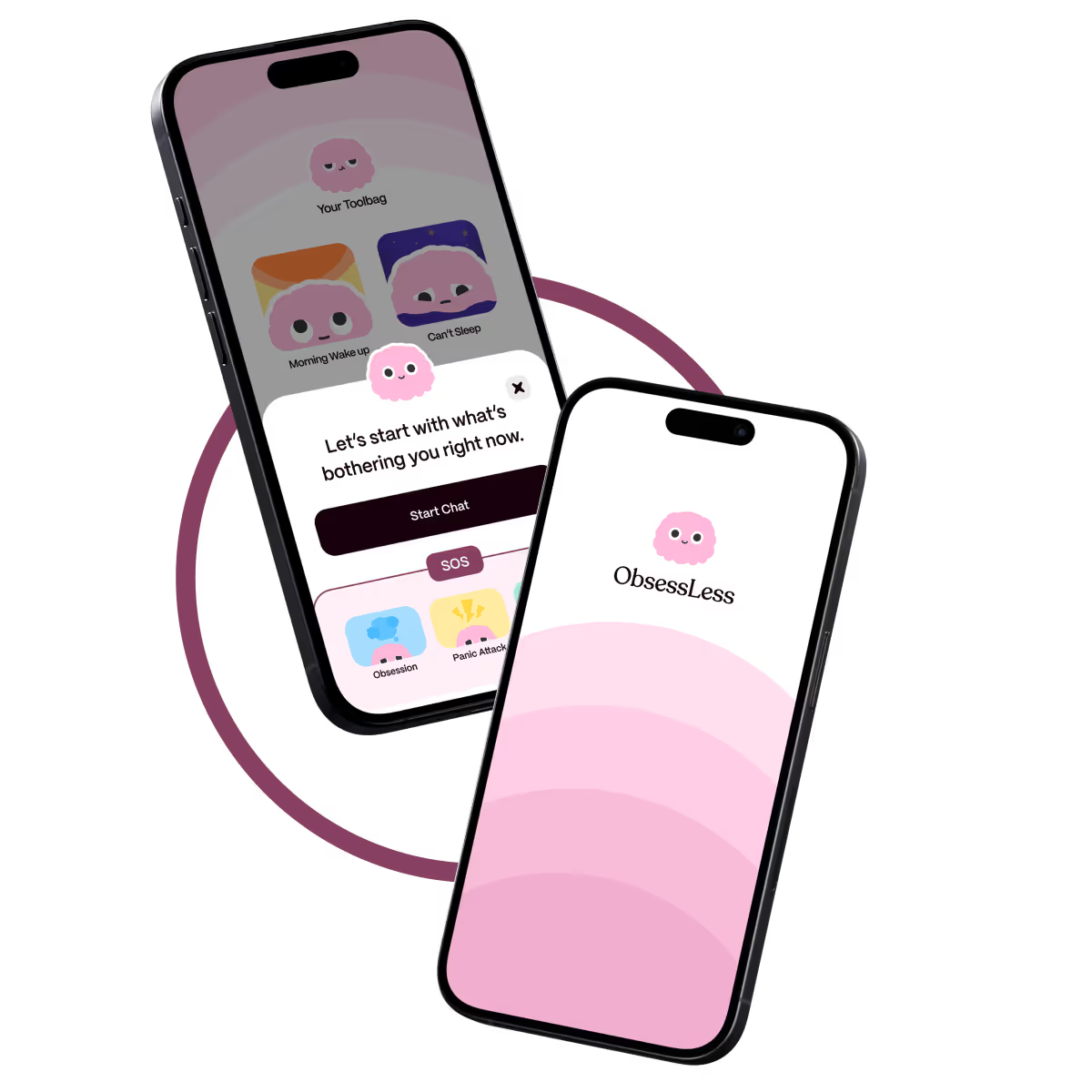
Get Instant OCD Support

Download the OCD Relief Guide